

“The hug you feel… is just the cold glass.”
Synth Pop / Experimental Pop Rock / Alternative Rock from Germany
Rockvyn, the artistic project of German songwriter and scientist Patrick Schmitt, has just released his new single, “Parasocial Metabolism”—a bold fusion of alternative rock, synth pop, and experimental rock that explores the emotional paradoxes of parasocial relationships in the digital age.
The song unfolds with an innovative poetic language, introducing neologisms like “heartillusion,” “touchdelusion,” and “warmvoid” to capture the strange blend of closeness and emptiness that defines our screen-mediated intimacy.
More than a critique, “Parasocial Metabolism” is an empathetic mirror: transforming one of the defining phenomena of our era into a deeply human, emotionally resonant, and musically accessible experience.
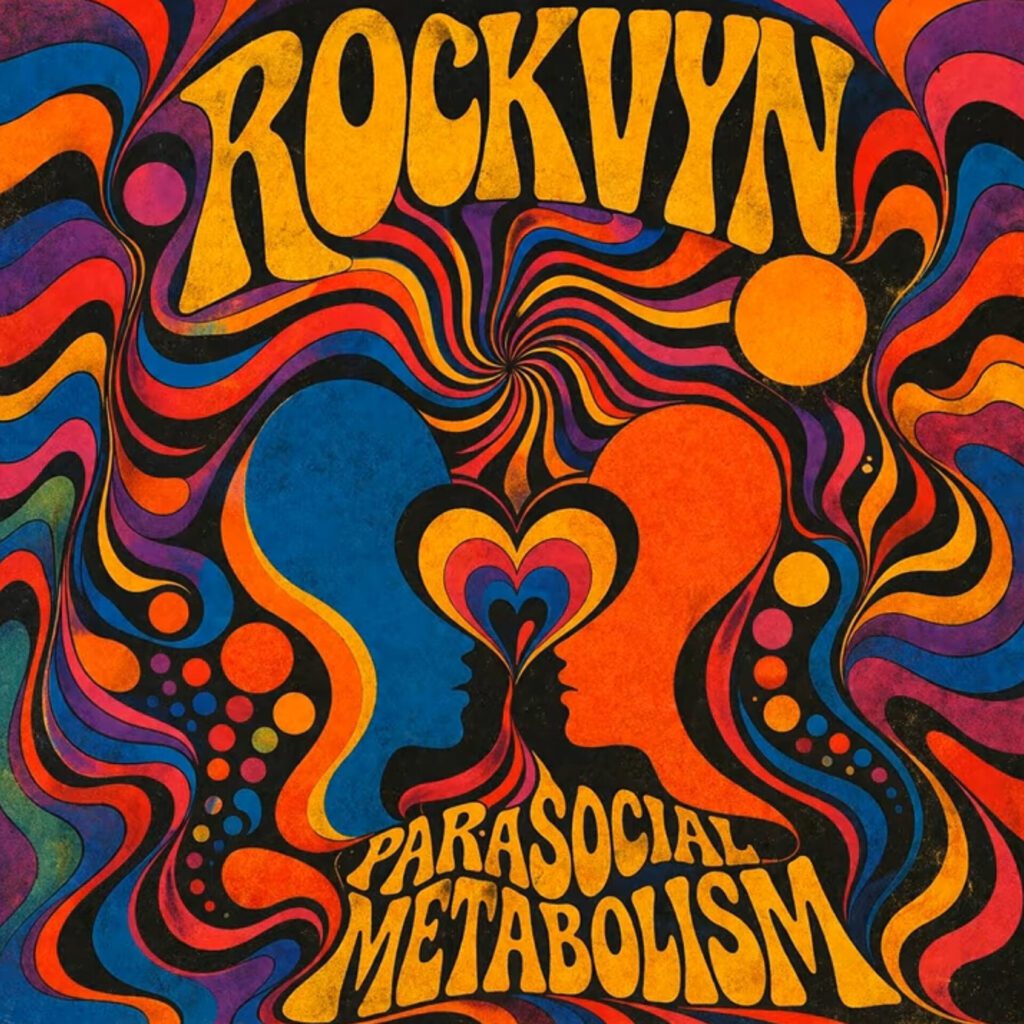
The Essence of “Parasocial Metabolism” (interview)
“Parasocial Metabolism” is a hell of a title, but it sounds like a psychology textbook. What’s the real-world story behind this track?
Rockvyn: “Yeah, I know, it’s a bit of a mouthful, right? But look around. We’re all guilty of it. You’re lying in bed at 2 AM, staring at a glowing screen, watching some streamer or scrolling through a profile, feeling this intense, warm connection. You feel like you know them. But the brutal truth? You’re completely alone in the dark. It’s an emotional fast-food diet. We swallow these digital illusions to fill a void, and that’s exactly what I mean by ‘metabolism’—our brains are digesting fake intimacy just to survive the night.”
The chorus is a tongue-twister of new words: ‘heartillusion,’ ‘touchdelusion,’ ‘nearnessless.’ Are you trying to reinvent the English language here?
Rockvyn: “Honestly? Standard words just felt too lazy for how weird our world has become. Take ‘nearnessless.’ It’s that exact, frustrating paradox of the digital age. You can see someone’s pores in 4K on your screen, they feel an inch away, but there is zero physical proximity. It’s a total mindfk. ‘Touchdelusion’ is your brain tricking you into feeling hugged when you’re actually just holding a cold piece of glass. I needed words that felt as broken and beautiful as the feeling itself.”
You use a lot of cat imagery—’purrfection,’ ‘like a kitten in your sleeve.’ It’s a very soft, cute contrast to a heavy rock song. Why the obsession with felines?
Rockvyn: “Because cats are the ultimate masters of conditional affection, aren’t they? But more importantly, a purring kitten is pure, unadulterated comfort. It’s safe. That’s what the internet is to us now—a ‘cotton-coated comfort.’ It’s so easy to slip into ‘dreampathy’ where nobody talks back, nobody argues, and everything is perfectly tailored to your needs. It’s comforting, sure, but it’s a paradise made of ice. It’s not real.”
The ending of the song gets surprisingly dark: ‘the purring peace turns feast… to the final, fatal feast.’ That sounds like a horror movie.
Rockvyn: “Because it is a bit of a horror movie! These digital spaces, these parasocial loops—they don’t just sit there. They feed on you. First, it’s just a comforting escape after work. Then, it steals your evening. Then, it starts replacing your real-world friendships because real humans are messy and complicated, while the screen is always perfect. Before you know it, the thing that comforted you has completely eaten your real life alive. You became the meal.”
You’re tackling this highly digital, futuristic theme, but you’re doing it with raw, classic rock guitars. Why not electronic synth-pop?
Rockvyn: “That would be too predictable, wouldn’t it? ‘Oh look, a song about computers with beep-boop noises!’ [grins] No, I wanted the exact opposite. Classic, alternative rock has sweat, grit, and moving air. When you crank an electric guitar, it vibrates in your chest. Putting that raw, bleeding, human energy right against a theme that is sterile and pixelated. That’s where the sparks fly. It forces the listener to feel the friction.”
The dynamics in the song are wild. The verses whisper, but the chorus absolutely explodes. Walk us through that choice.
Rockvyn: “The verses are meant to feel like the trap itself. It’s that hypnotic, quiet whisper of the screen pulling you in—‘flickering frames of phantom friends.’ It’s cozy. But the chorus? That’s the wake-up call. It’s the sudden, loud realization of your own loneliness. I wanted the chorus to feel like someone ripping the headphones off your ears and forcing you to face the quiet room you’re sitting in.”
Between this, «Lovgorithm,» and «The Mindmachine,» you seem slightly obsessed with how technology is changing us. Are you a bit of a tech-hater?
Rockvyn: “Not at all! I’m a nerd, I love tech, and I’m incredibly grateful that a guy like me can record music and instantly share it globally. I’m not saying ‘throw your phones in the river.’ I’m just holding up a mirror to my own generation. I want people to rock out to the music, scream the lyrics, and then, hopefully, turn the screen off, look at the person sitting next to them, and have a real, messy, unedited conversation.”

More About Rockvyn
Rockvyn is the artistic alter ego of Patrick Schmitt (b. 1992 in Mainz, Germany), a molecular biologist turned rock musician who inhabits a rare space where the precision of genetic engineering meets the raw force of classic rock.
Educated at Johannes Gutenberg University Mainz, with additional training in law, an MBA in London, and further studies at Stanford, MIT, and Harvard Medical School, he has designed genetically modified microorganisms, published in the British Medical Journal, filed patents, and been mentioned in Nature.
Yet beneath this formidable résumé lies a musician whose roots trace back to the Peter-Cornelius Conservatory in Mainz, where he learned guitar, piano, and received early musical education.
Rockvyn’s music is where structure and instinct collide—intellectually sharp, emotionally direct, and unmistakably his own.
In March 2026, his song “The Color We Forgot” was nominated in the “Open” category at the German Songwriting Awards, one of Germany’s most prestigious music honors, judged by representatives from Universal Music, Warner Music, Sony Music, and BMG.
Parasocial Metabolism • Rockvyn • Indie Valley Music Review
“Parasocial Metabolism” is an energetic, vibrant, and structurally unpredictable work that defies genre categorization. While rooted in the intersection of alt rock and synth pop, its DNA weaves subtle influences from psychedelic rock, experimental rock, and pop rock, crafting a unique identity: authentic, relatable, and conceptually rich.
At 102 BPM and 3:16 in length, the song opens instantly with a synth, unfolding a spatial, enveloping layer—like a smooth airplane landing—processed with soft compression that creates an almost sponge-like texture. A synthetic harp-like arrangement briefly emerges, evocative and celestial, like a digital dawn.
At 0:09, the rhythmic foundation enters: an organic drum performance with a subtle 70s groove, masterfully processed to sound wide, modern, and present—never overwhelming. Its rhythm is catchy, full-bodied, yet balanced.
Soon after, the bass joins with a minimalist, precise, and deep line, subtly octaved and touched with light fuzz, adding attitude and clarity. Rockvyn’s voice emerges with confidence, optimism, and a seductive nuance: soft yet firm, airy yet direct, with a barely-there chorus that adds weight without sacrificing naturalness. Every word is clear, inviting the listener into the conceptual narrative.
The verses flow with fresh, youthful, carefree energy, until at 0:30 an instrumental break—rhythmic synth only—builds a brief crescendo that reintroduces the narrative at 0:34 with deeper conceptual weight.
At 0:53, the electric guitar bursts in with controlled-distortion riffs, evoking the alt/indie rock of the 2000s—reminiscent of Interpol or The Killers—transporting the listener to a past decade, yet rendered with modern, forward-thinking production.
At 1:16, the first chorus arrives: melodic, catchy, but never overpowering. Everything flows in compact harmony. After its close at 1:34, an oriental-tinged arpeggio—synth-emulated sitar—introduces a new atmospheric layer.
At 1:43, the unexpected happens: a bubbling synth solo, expertly panned across stereo and center, creates a three-dimensional, spatial experience, balancing synth pop with experimental and progressive sensibilities.
The second verse section (from 1:54) maintains an exquisite duality: soft yet vibrant. The second chorus (2:12–2:30) subtly elevates intensity, closing with an electronic sitar-like tremolo.
At 2:33, a drum fill announces a new verse section with chorus-like energy, culminating in a sustained vocal modulation (“ehhhhh…”) at 2:54, followed by an “indietronic” guitar solo and a “siren”-style synth lead that guide the instrumental climax.
The track fades into ethereal layers, like a final call: “Put down your phone. Embrace the real world.”
“Parasocial Metabolism” doesn’t just sound—it awakens.
It’s a great honor for us to present this new release, “Parasocial Metabolism” by Rockvyn. Go listen to the song on your favorite streaming platform.