

“Controlled chaos. Contained rage. And then… the clock keeps ticking.”
Noise Rock From Leicester, UK
The noise rock band Dusker, based in Leicester, England, has just released their latest single, “Pissing in the pool” —an intense, shifting, and masterful piece that marks the beginning of a new creative era.
Recorded and mixed entirely DIY in their own studio—built from scratch by the band in a hometown industrial unit—this track is the first of five singles previewing their second album, due in mid-2027.
“Pissing in the Pool” seeks an organic progression from their 2025 debut LP, “limb rung ladder”, blending their raw post-hardcore sound with influences from math rock, progressive rock, post-rock, and even hints of jazz, all woven together with mastery and narrative intent.
More About Dusker
Dusker is an off-kilter noise-rock band formed in 2018 in Leicester, composed of Jordan Delaney, Rory Booth, Todd Finnamore, and Lewis Bates.
Their music is anchored by biting vocals that empathetically explore themes of broken lives, unreal experiences, and bitter remembrance. The sound ebbs and flows with dynamism and catharsis: angular guitars, urgent percussion, and unpredictable structural turns mirror the complex and ambiguous stories at its core.
They have toured extensively across Britain, Germany, Poland, and the Czech Republic, establishing a live presence as intense as their recorded output.
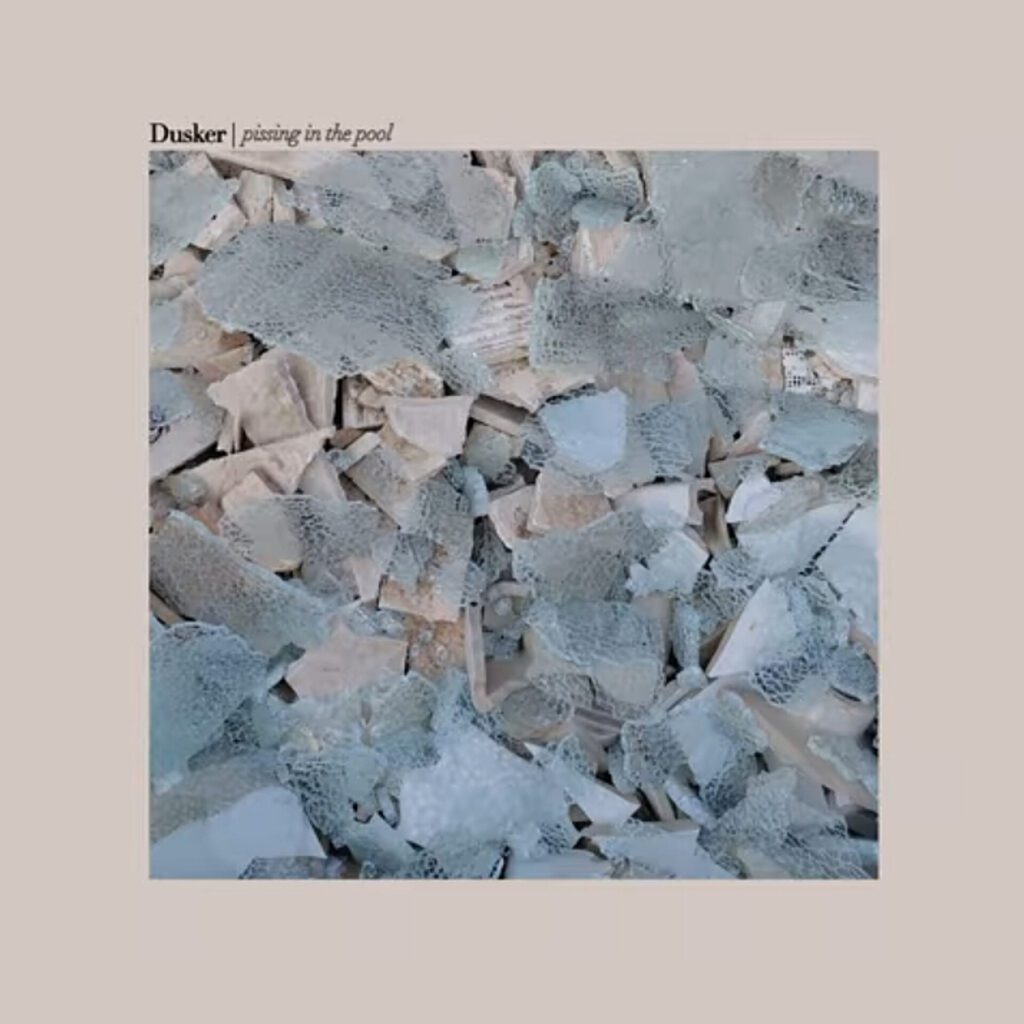
Pissing in the pool • Dusker • Indie Valley Music Review
“Pissing in the pool” is, without a doubt, a masterpiece of controlled tension. While rooted in noise rock and post-hardcore, the song expands with influences from math rock, progressive rock, and post-rock, unfolding exquisite dynamics and versatile progressions that transform the listening experience into something unique.
The track opens with an electric guitar playing punctuated riffs with controlled saturation and reverb, instantly establishing an identity that is vibrant, bold, and slightly unsettling. At 0:03, the drums erupt: wide, energetic, almost thunderous, with a mathematical, millimeter-precise rhythm that channels the spirit of math rock. Together with the bass, they create a pulsing, exact foundation, crafting an intro that feels like “controlled chaos”—an oxymoron perfectly suited to its essence.
This section culminates at 0:24, when the rhythm shifts to something more linear, and an ethereal, saturated cry (“ohhhhhh…”) emerges, softly fading to make way for the lead vocal at 0:28.
The delivery is narrative, direct, almost spoken with anger, as if interrupting an uncomfortable situation with contained fury. The voice—slightly above the instrumentation, yet in perfect harmony—conveys rebellion, irritation, and urgency, while the music maintains vibrant, cohesive energy.
At 1:05, an unexpected structural turn: a second, soft and melodic voice enters, creating a harmonic contrast that adds emotional depth. This section flows until 1:48, when a powerful drum fill signals the return of the verses—now with greater vocal intensity and a backdrop of brief but striking tribal shouts —akin to Indigenous war cries—, a surprising element that heightens the listener’s curiosity.
Tension builds through a subtle yet palpable crescendo, until the voice erupts into shouted, pitch-perfect, emotionally charged lines. But just as it seems there’s no turning back, at 2:16, everything calms: the soft secondary voice returns, the instrumentation moderates, and the narrator adopts a more subdued tone… only to explode again moments later in contained fury.
Here, vocal duality shines: the lead voice shouts in desperation, bordering on the guttural, while a gentle supporting voice creates a hypnotic contrast, amplifying the sensory and cathartic sensation.
At 3:00, a radical structural break: the band temporarily abandons noise rock to enter an ethereal, immersive, atmospheric soundscape, clearly influenced by progressive rock and jazz. The drums adopt a groove reminiscent of bossa nova, and the lead voice—now in a deep, weary register—narrates from a low emotional state, yet with a presence that commands attention.
At 3:33, math rock returns, but this time accompanied by that calmer vocal delivery, creating fascinating tension. The electric guitar takes center stage with bright, saturated riffs, expertly panned to generate three-dimensionality and an enveloping stereo field. Bass and drums maintain a dynamic yet precise foundation, comforting amid the chaos.
At 3:55, a distorted guitar solo—subtle, measured, yet technically impeccable—weaves through celestial, airy, reverberant vocal layers, adding an emotional, post-rock dimension. The song reaches its most vibrant and liberating climax: a fusion of progressive instrumentation, ethereal vocal arrangements, and cathartic energy that evokes an almost celestial feeling.
This climax holds until 4:35, when only bass and drums remain, fading out calmly… and in the background, the tick-tock of a clock, reminding us that not even catharsis stops time.
The production is masterful, with meticulous attention to every sonic detail. The mixing and mastering are top-tier, delivering a sound that is polished, crisp, deep, and comforting—noise rock that makes sense, where chaos has clarity and intensity has purpose. It’s a sound suitable for any playback system.
“Pissing in the pool” is more than a song—it’s a structurally audacious journey, where noise rock, math rock, prog, and post-rock converge in harmony, offering an experience that is dynamic, emotionally rich, and technically flawless. Ideal for discerning listeners who seek complexity without losing human connection.
It’s a great honor for us to present this new release, “Pissing in the pool” by Dusker. Go listen to it on your favorite streaming platform.